A look inside the workbook
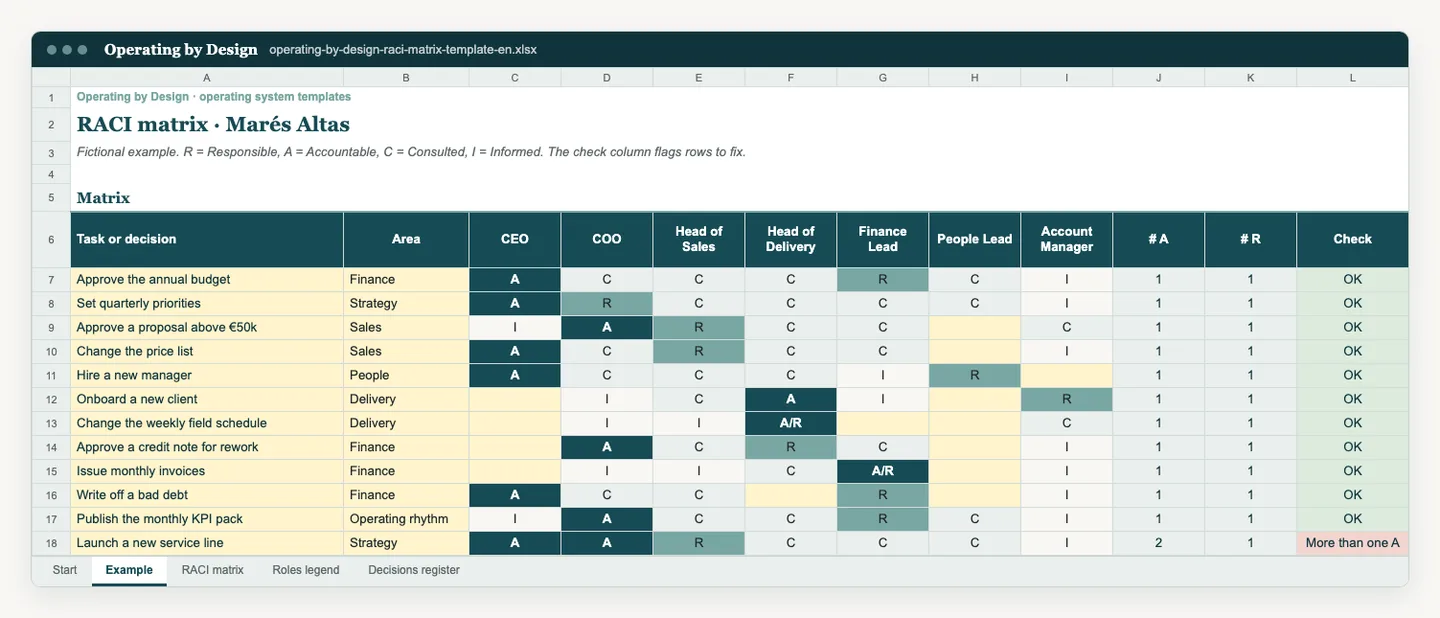
What it is and what it is for
A RACI matrix makes roles explicit for each task or decision in a process or project: R for who does the work, A for who approves and answers for the outcome, C for who is consulted beforehand and I for who is informed afterwards. The template maps tasks and decisions against roles, uses drop-down lists to avoid entry errors and automatically checks that each row has exactly one A and at least one R.
Who uses it and when
Leadership teams, project managers and process owners who need to clarify who does what in a change, a cross-functional project or a recurring process. It is especially useful when several teams touch the same work.
Build the matrix at project kick-off or when reviewing a process, and revisit it when people, roles or scope change. For a stable process, a review every six months is usually enough.
How to use the template
- 1.List the tasks and decisions in the process or project, one per row. Use concrete verbs, such as “approve budget” or “appoint supplier”.
- 2.Put roles in the columns rather than people’s names, so the matrix survives team changes.
- 3.In each cell, choose R, A, C or I from the drop-down list. Leave it blank where the role has no part.
- 4.Check the automatic flags and fix any row with no A, more than one A or no R.
- 5.Keep C to the essentials: every person consulted adds time to the decision.
- 6.Validate the matrix with the people involved and store it with the process or project documentation.
Data access and limitations
A RACI only works if it is used in real decisions; if nobody looks at it, roles become implicit again. Avoid matrices with dozens of columns and rows, which become unreadable. The matrix does not replace a conversation about expectations with each person. The Marés Altas example is fictional and its allocation of roles is not a recommendation. The file contains no macros.
Common questions
What does RACI stand for?
Responsible (who does the work), Accountable (who approves and answers for the outcome), Consulted (who gives input beforehand) and Informed (who is told afterwards).
Why can each row have only one A?
Because the A answers for the outcome and has the final say. With two, the decision waits for consensus and nobody is really accountable.
When should we use a RACI and when an accountability matrix?
Use a RACI for tasks and decisions within a process or project. Use an accountability matrix to set who owns the company’s major outcomes and areas.
References and use
These are practical Operating by Design resources. Suggested cadences and quantities are starting points, not universal standards. References consulted on 16 October 2026:
Adapt the workbook for internal use in your organisation. Preserve the source attribution. Avoid unnecessary personal data.
From template to implementation
If the challenge needs more than a template, leadership alignment and a cadence that holds, see how we implement this with teams.
Explore the related service

