A look inside the workbook
What it is and what it is for
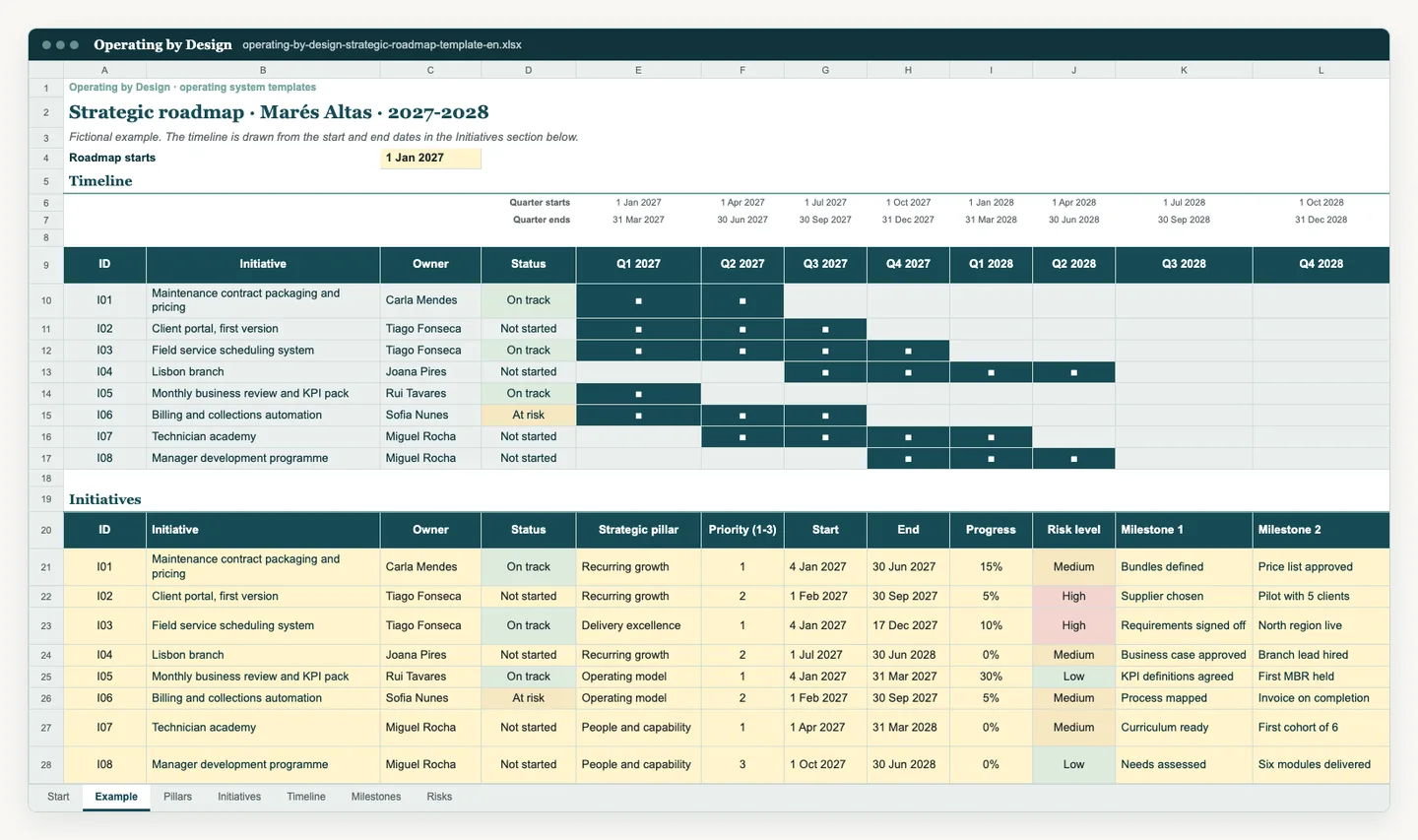
A strategic roadmap shows how the company will move from strategy to execution over time. This template lists strategic initiatives with priority, owner, start and end dates, milestones, dependencies, progress and risks, and automatically builds a timeline view by quarter. The leadership team can see at a glance what runs in parallel, where there is overload and which initiatives depend on others.
Who uses it and when
Founders, CEOs and leadership teams who need to communicate a twelve to eighteen-month strategic plan. Each initiative has an owner in the leadership team. Investors and boards can receive the timeline view as a summary of the plan.
Build the roadmap during annual planning and review it every quarter, alongside quarterly planning. Update progress and risks monthly. Priority changes should be recorded, not made quietly.
How to use the template
- 1.Start from the twelve to eighteen-month strategic objectives and list the initiatives needed to reach them. Each initiative should link to at least one objective.
- 2.Give each initiative a priority and a single owner. If two initiatives compete for the same people, decide now which comes first.
- 3.Enter start and end dates and two or three milestones per initiative. Milestones should describe deliverables you can check, not activity.
- 4.Record dependencies between initiatives. An initiative that depends on another should not start before the milestone it needs is scheduled.
- 5.Check the quarterly timeline view. If one quarter carries too many initiatives, rebalance or cut before you communicate the plan.
- 6.Update progress and risks every month and review the roadmap at the start of each quarter.
Data access and limitations
A roadmap is not a promise of dates: it is the best current hypothesis and should change when reality changes, with the reason recorded. Avoid sharing versions with sensitive information about people, customers or investments outside the company. The Marés Altas example is fictional; its initiatives and dates only illustrate how to fill in the template and are not benchmarks. The file contains no macros.
Common questions
What is the difference between a strategic roadmap and a strategic plan?
The strategic plan sets out where the company wants to go and why. The roadmap shows how and when: which initiatives, in what order, with which owners and dependencies.
What time horizon should a strategic roadmap cover?
Twelve to eighteen months works well for most SMEs and scale-ups. The first quarters should carry more detail; later ones can stay at initiative level.
How should we handle initiatives that slip?
Record the delay, the reason and the impact on dependencies. Then decide explicitly: move dates, add resources or take another initiative out of the plan.
References and use
These are practical Operating by Design resources. Suggested cadences and quantities are starting points, not universal standards. References consulted on 16 October 2026:
- Harvard Business Review · Turning Great Strategy into Great Performance
- MIT Sloan Management Review · No One Knows Your Strategy, Not Even Your Top Leaders
Adapt the workbook for internal use in your organisation. Preserve the source attribution. Avoid unnecessary personal data.
From template to implementation
If the challenge needs more than a template, leadership alignment and a cadence that holds, see how we implement this with teams.
Explore the related service

