A look inside the workbook
What it is and what it is for
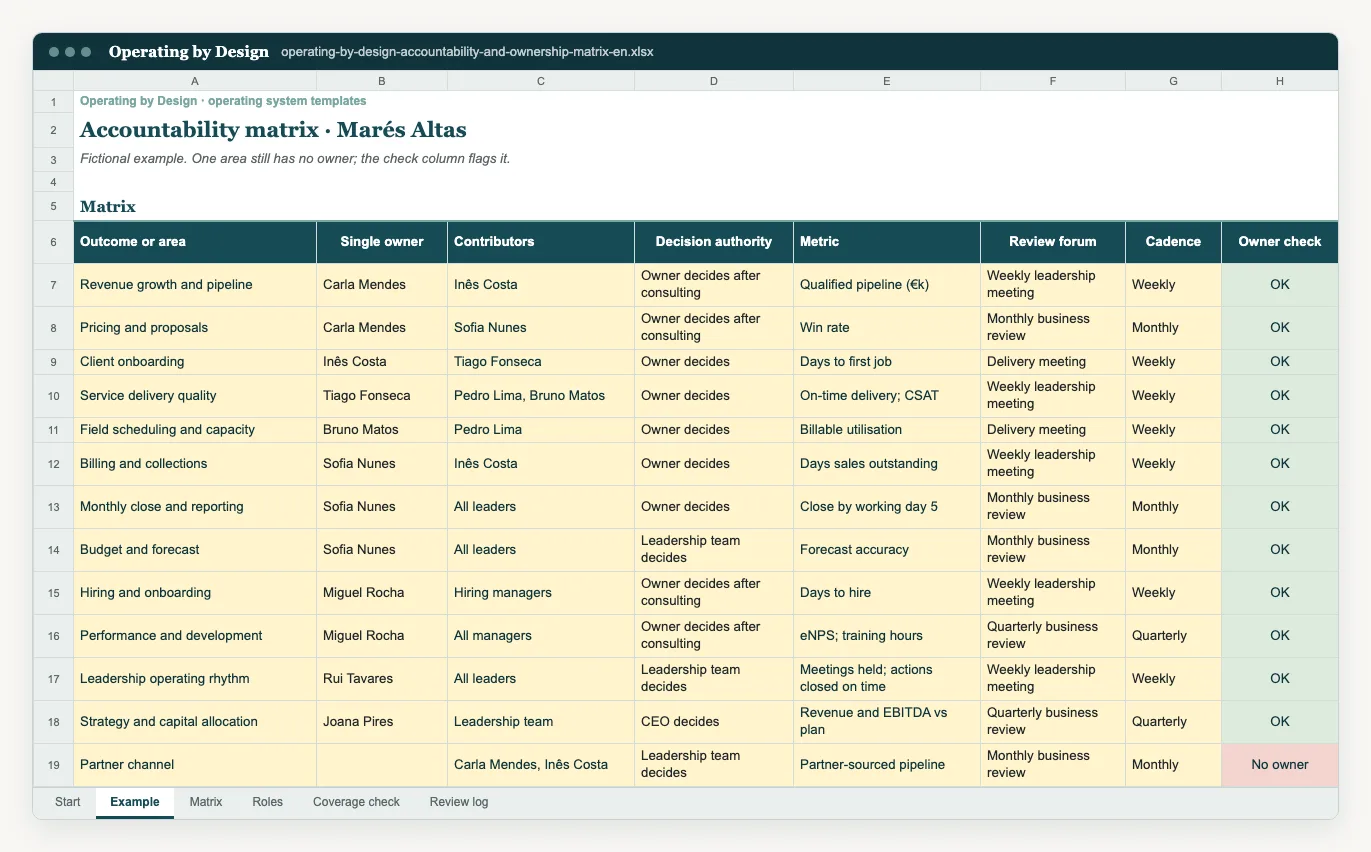
Accountability starts with knowing, without ambiguity, who answers for each outcome. This matrix lists the company’s outcomes and areas and gives each one a single owner, its contributors, decision authority, the metric that shows whether it is on track and the forum where it is reviewed. An automatic coverage check flags areas with no owner, which are usually the ones that end up back with the founder.
Who uses it and when
Founders and CEOs who want to stop being the decision point for everything, and leadership teams that are growing or reorganising roles. The leadership team builds the matrix together and each owner confirms what is theirs.
Build the matrix in one leadership session and review it whenever the structure changes, a leader is hired or a new business area opens. Otherwise, a review every six months is usually enough.
How to use the template
- 1.List the outcomes and areas the company needs to manage, from sales to cash. Write them as outcomes, not departments.
- 2.Give each row a single owner. If two people seem to own it, split the area or decide who answers for it.
- 3.Add contributors and set decision authority: what the owner decides alone and what needs approval.
- 4.Choose one metric per area and the forum where it is reviewed, such as the weekly meeting or the monthly business review.
- 5.Check the coverage flags and deal with any unowned areas before you share the matrix.
- 6.Share the matrix with the leadership team, confirm it with each owner and use it whenever someone asks “who decides this?”.
Data access and limitations
Accountability is not blame: the matrix sets out who answers and decides, not who is punished when something goes wrong. An owner with no decision authority or resources is not really accountable. Keep the matrix current after structural changes. The Marés Altas example is fictional and its structure is not a recommendation for your company. The file contains no macros.
Common questions
What is the difference between an accountability matrix and a RACI matrix?
An accountability matrix works at the level of company outcomes and areas, with a single owner for each. A RACI works at the level of tasks and decisions in a process or project, with several roles per row.
Can two people own the same area?
They should not. With two owners, decisions wait and problems fall between them. Split the area into distinct outcomes or decide who answers for it.
What should we do with unowned areas?
Assign them before you share the matrix, even temporarily. An area without an owner almost always ends up with the founder or CEO.
References and use
These are practical Operating by Design resources. Suggested cadences and quantities are starting points, not universal standards. References consulted on 16 October 2026:
- Harvard Business Review · Who Has the D? How Clear Decision Roles Enhance Organizational Performance
- Atlassian · RACI chart: what it is and how to use it
Adapt the workbook for internal use in your organisation. Preserve the source attribution. Avoid unnecessary personal data.
From template to implementation
If the challenge needs more than a template, leadership alignment and a cadence that holds, see how we implement this with teams.
Explore the related service

