A look inside the workbook
What it is and what it is for
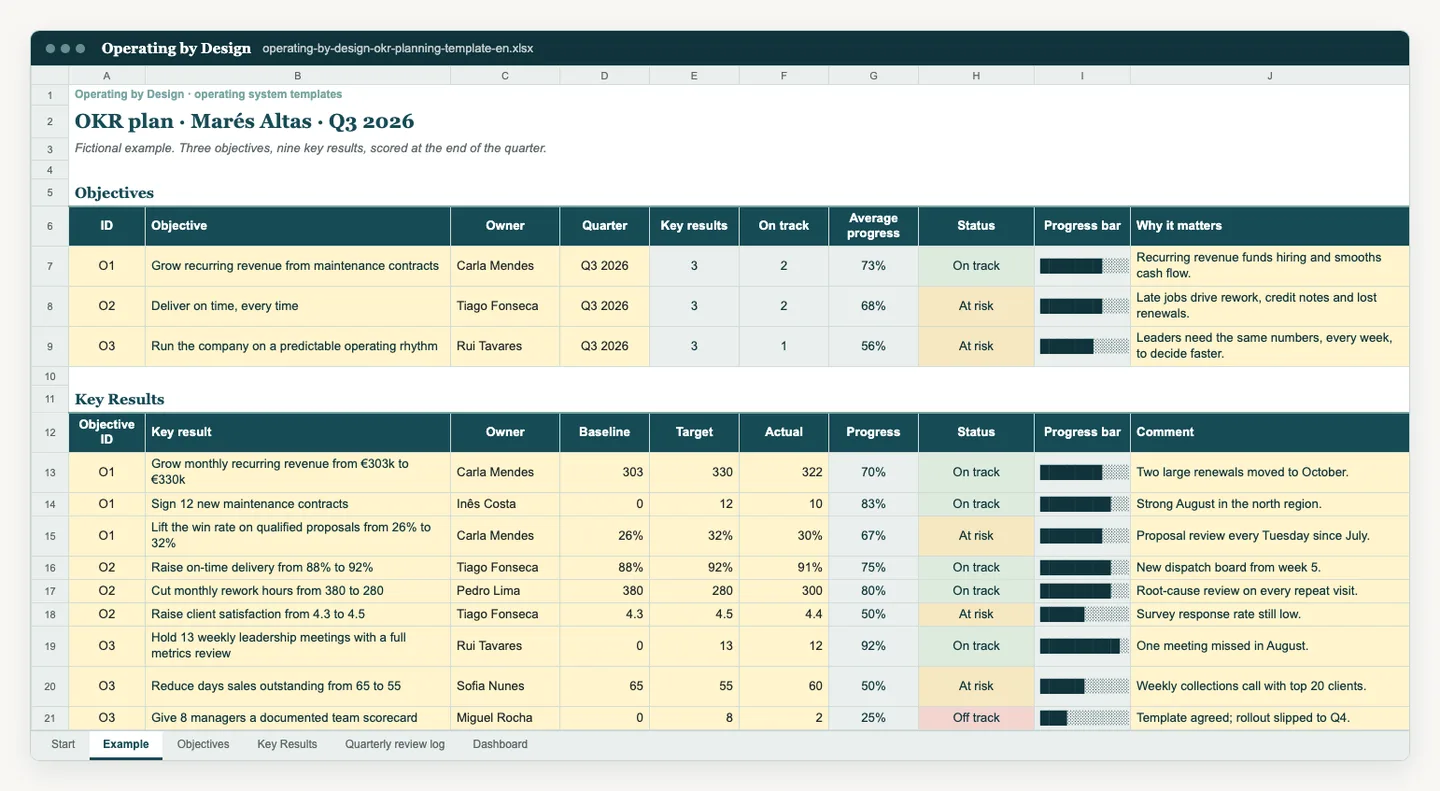
OKRs pair a qualitative objective with a small set of measurable key results. The objective says where the company wants to go this quarter; the key results say how you will know it got there. This template keeps objectives, key results, owners, baselines, targets and actuals in one place. Progress and status are calculated from the numbers you enter, so every review starts from the same facts.
Who uses it and when
The CEO and leadership team set company objectives. Each key result has one owner who updates the actual and explains the gap. Team leads can use the same structure for team OKRs linked to a company objective. Someone in an operations or chief of staff role usually maintains the file and runs the review.
Draft OKRs in the last two weeks of the previous quarter, update actuals weekly or fortnightly and score them at quarter end. Log each review in the file so decisions and changes stay visible. Adjust the rhythm to your planning cycle.
How to use the template
- 1.Choose three to five company objectives for the quarter. Write each as a clear statement of where you want to be, not a list of tasks.
- 2.Add two to four key results per objective. Each must be measurable, with a baseline from today and a target for quarter end. If you cannot measure it, it is probably an initiative rather than a key result.
- 3.Name a single owner for each key result. There can be many contributors; the owner is the person who updates the number and explains the gap.
- 4.Enter the baseline and target in the yellow cells. Progress and status calculate automatically; do not type over the formulas.
- 5.Update actuals on a fixed day, weekly or fortnightly. Use the dashboard to open the leadership meeting with the objectives that are off track.
- 6.At quarter end, record the final score and the lessons in the review log. Then decide whether each objective continues, changes or drops out of the next cycle.
Data access and limitations
Keep OKRs separate from individual pay and bonus decisions: linking them encourages safe targets. Agree where each actual comes from before the quarter starts, so the number is not debated in every review. The Marés Altas example is fictional; its figures show how the template works and are not benchmarks for your company. The file contains no macros and can be adapted.
Common questions
How many OKRs should a company have?
Few. Three to five company objectives, each with two to four key results, is a common starting point. More than that usually means the leadership team has not yet chosen.
What is the difference between OKRs and KPIs?
KPIs track the ongoing health of the business. OKRs describe the change you want to make this quarter. A KPI can become a key result when you deliberately decide to move it.
How is progress calculated?
Progress measures how far the actual has moved from the baseline towards the target. Status classifies each key result from that progress, using the criteria explained on the instructions sheet.
References and use
These are practical Operating by Design resources. Suggested cadences and quantities are starting points, not universal standards. References consulted on 16 October 2026:
- Google re:Work · Set goals with OKRs
- What Matters · John Doerr, Measure What Matters and the OKR methodology
Adapt the workbook for internal use in your organisation. Preserve the source attribution. Avoid unnecessary personal data.
From template to implementation
If the challenge needs more than a template, leadership alignment and a cadence that holds, see how we implement this with teams.
Explore the related service

