A look inside the workbook
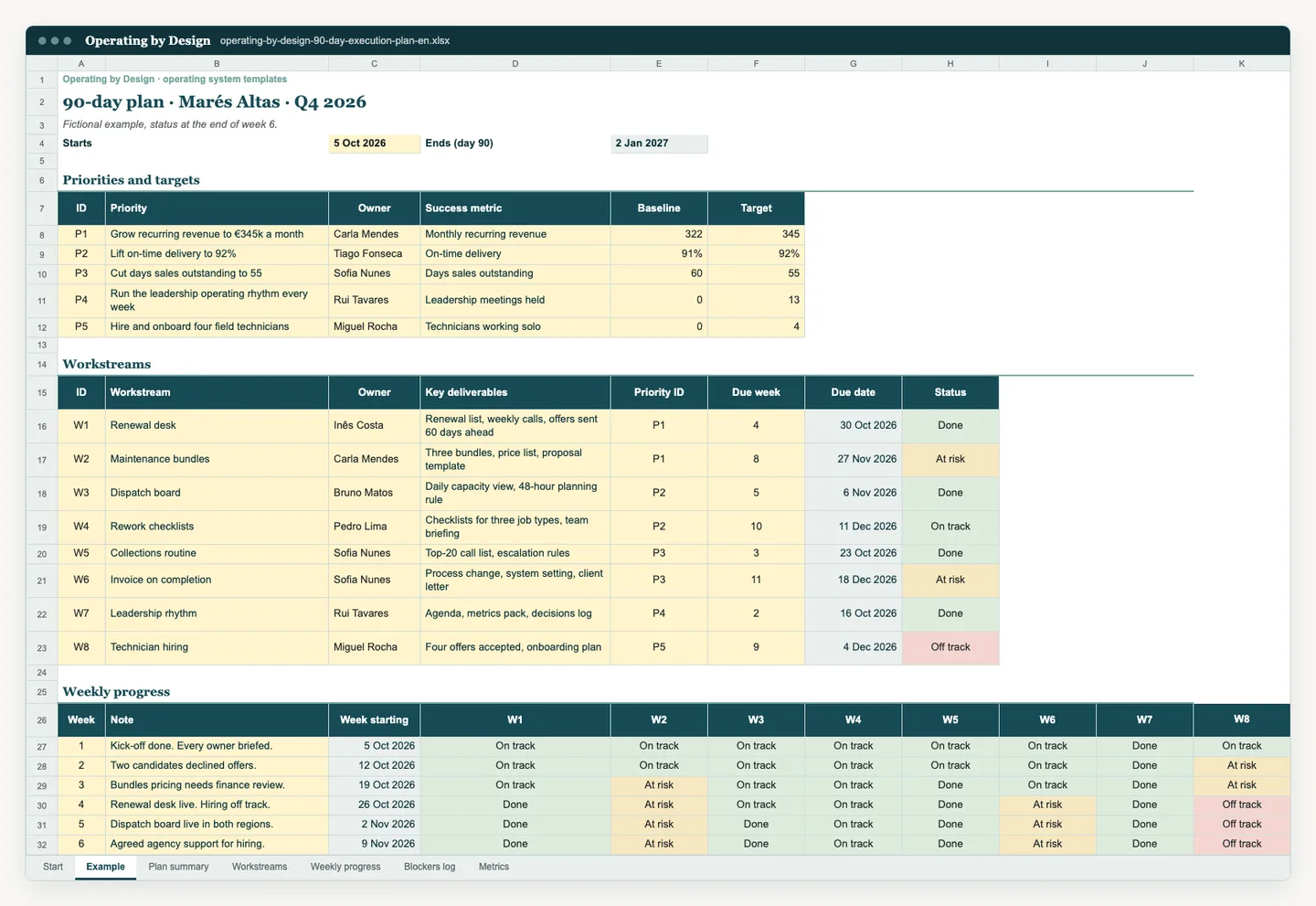
What it is and what it is for
A 90-day plan focuses a period short enough to keep urgency and long enough to deliver something meaningful. The template breaks priorities into workstreams, deliverables, owners and milestones, tracks progress in each of the thirteen weeks and records blockers and success metrics. Use it for a new role, an operational change or the first quarter of a new management system.
Who uses it and when
Founders and CEOs who want to speed up a specific change, new leaders in their first months in role and leadership teams launching a cross-functional initiative. Each workstream has an owner; the plan’s sponsor follows weekly progress.
Build the plan in one session before kick-off. Update weekly progress on the same day each week, in a fifteen to thirty-minute review. Hold a longer checkpoint in weeks four and eight and a final review in week thirteen.
How to use the template
- 1.Set no more than three priorities for the 90 days and a success metric for each. If you do not know how you will measure success, clarify that before you plan.
- 2.Break each priority into workstreams with an owner and the expected deliverables.
- 3.Spread milestones across the thirteen weeks. Put at least one milestone in the first four weeks to build momentum early.
- 4.Each week, update progress in the yellow cells and log blockers with an owner and a date to resolve them.
- 5.In weeks four and eight, compare progress with the milestones and decide whether scope, resources or dates need to change.
- 6.In week thirteen, assess the success metrics, record what is left and decide whether it continues in a new cycle or moves into normal operations.
Data access and limitations
A 90-day plan works by exclusion: adding priorities halfway through dilutes focus. Log blockers even when they are uncomfortable, because a plan that only shows green stops being useful. The Marés Altas example is fictional and does not represent timing or performance benchmarks. The file contains no macros and can be adapted to a different length.
Common questions
What is a 90-day plan for?
To concentrate execution in a short period, with few priorities and visible progress every week. It suits new roles, operational changes and the first cycle of a new management rhythm.
How is a 90-day plan different from quarterly planning?
Quarterly planning covers the whole company’s priorities. A 90-day plan is narrower: it serves one person, one team or one specific change, with detailed weekly follow-up.
What should happen when a workstream is blocked?
Log the blocker with an owner and a date and bring it to the weekly review. If it stays blocked two weeks running, the decision goes up to the plan’s sponsor.
References and use
These are practical Operating by Design resources. Suggested cadences and quantities are starting points, not universal standards. References consulted on 16 October 2026:
- Harvard Business Review · Why Strategy Execution Unravels, and What to Do About It
- Harvard Business Review · Turning Great Strategy into Great Performance
Adapt the workbook for internal use in your organisation. Preserve the source attribution. Avoid unnecessary personal data.
From template to implementation
If the challenge needs more than a template, leadership alignment and a cadence that holds, see how we implement this with teams.
Explore the related service

